
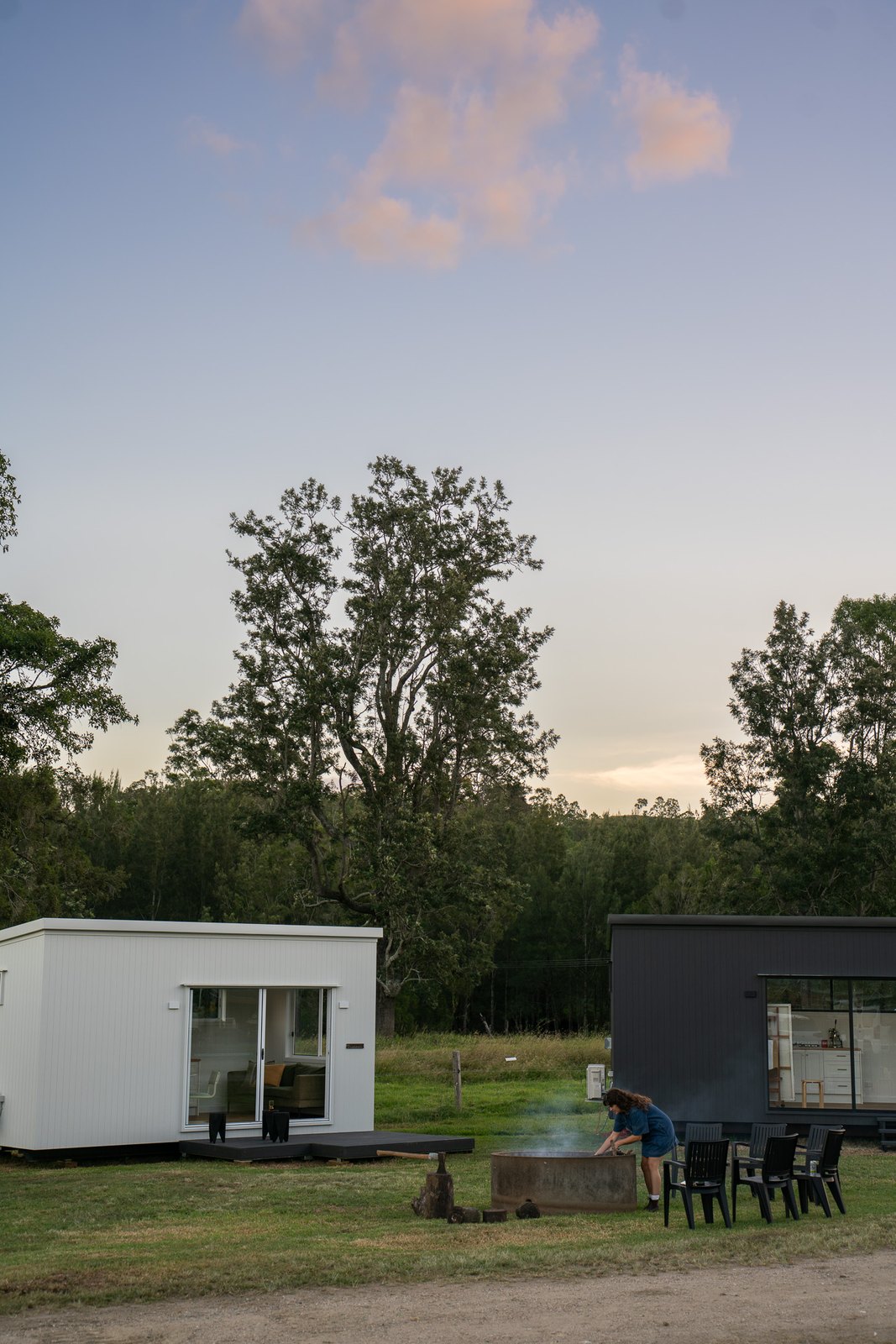
The words describe how a home is built and how it arrives, and the law does not care about any of them. A modular home is built in a factory in one or more modules and craned onto footings. A transportable or relocatable home is the same thing in older language, often a single module on its own chassis. A kit home is a set of parts delivered flat and built on the block by a builder or an owner builder. A site-built home is built in place from the slab up. A tiny home on wheels is a trailer. What the law asks is one question: is it fixed to the land and used as a Class 1a dwelling? If yes, it needs building and plumbing approval and a licensed install whatever it is called. If it stays on wheels and off the services, it is a caravan.
The five, side by side
| Kind | How it is built and arrives | Price basis to expect | Who installs |
|---|---|---|---|
| Modular | One or more modules finished in a factory, trucked in, craned onto piers, joined on site if more than one | Ex factory, sometimes turn-key | The maker, a licensed builder, or an owner builder |
| Transportable or relocatable | A single module, often on a steel chassis, delivered on a tilt tray or towed, set on piers | Ex factory or delivered | The same three |
| Kit or flat pack | Frames, cladding, roofing and fittings delivered as parts; built on the block over weeks | The kit only. Labour, footings, services and approvals are on top | A licensed builder or an owner builder with trades |
| Site-built | Built in place from the footings up, like a small house | Turn-key, usually, from a builder | A licensed builder |
| Tiny home on wheels | A dwelling-shaped trailer, registered as a caravan | The unit, delivered | Nobody, while it stays on wheels and off services |
What the law calls them
The QBCC groups all of the first four under one heading, small modular residential buildings, and lists pods, flat pack studios, transportables, relocatables, modular homes and granny flats together. Its rule is the same for all: a structure fixed to the ground by footings, tie-downs or service connections and used as a Class 1a dwelling is residential construction work, so it must be installed by a QBCC-licensed contractor or an owner builder with a permit. The state's planning page says the same from the other side: a tiny home fixed to the land with a kitchen, bathroom, toilet and laundry is a dwelling, and small homes fixed as a permanent use are encouraged as secondary dwellings across the state.
The National Construction Code sorts buildings by use, not by how they were built. A single dwelling is Class 1a; a shed, studio or garage is Class 10a. Class 1a or 10a explains why that decides everything that follows.
What changes between them
- Time on site. A modular home is on its piers in a day and connected in weeks. A kit takes a crew weeks to months. A site build takes months.
- Where the price stops. A kit price is the parts. A modular price is usually the home at the factory door. Only turn-key and site-built prices include the install. Installed versus ex factory.
- Width. A module is limited by the road, so single modules run about 3.4 to 4.5 m wide and wider homes come in two. A kit or site build has no such limit.
- Warranty. On a licensed install the home warranty scheme covers the site work and, for a modular home, the delivered home as a material; defective products themselves are the maker's warranty. On a kit the builder's warranty covers the assembly. What the warranty covers.
- Leaving. A home on wheels can leave. Everything else is part of the land once it is fixed, and the council caps and setbacks apply to it in full.
Kit homes versus modular homes compares the first two in detail.
See it for your block
Questions people ask next
What is the difference between a modular home and a transportable home?
Little. Both are built in a factory and delivered whole. Transportable usually means a single module on its own chassis, delivered on a tilt tray; modular can be one or several modules craned onto piers and joined on site. The law treats them the same once fixed to the land.
Is a kit home cheaper than a modular home?
The kit itself usually costs less, because it is a set of parts. Labour, footings, services, approvals and the builder's time are on top, and on a granny flat they can add up to more than the kit. Compare both at the installed price.
Does a transportable home need council approval?
A transportable home fixed to the land as a dwelling needs a building approval and a plumbing permit like any house, and a planning approval only if the council's scheme makes it assessable. The QBCC says installing it is residential construction work that needs a licensed contractor.
- QBCC, FAQs: tiny homes in Queensland (small modular residential buildings, when installation is residential construction work), read 16 October 2026
- Queensland Government, tiny homes (fixed tiny homes are dwellings; on wheels and unconnected they are caravans), read 16 October 2026
- ABCB, National Construction Code building classifications, read 16 October 2026
- Queensland Government, sharing the road with oversize, pilot and escort vehicles, read 16 October 2026
- Homes on this site: kind, width and price basis for every listed home, each read from the maker's page with the date, read 16 October 2026