
Toowoomba sits on top of the Great Dividing Range, west of Brisbane, and its rules read differently from the coastal councils. The region covers the city itself, from the older streets of East Toowoomba, Mount Lofty and Rangeville to the newer estates at Glenvale, Highfields and Kearneys Spring, plus the country towns and a lot of rural land between Crows Nest, Oakey, Pittsworth and Millmerran.
The short version, checked October 2026: the planning scheme sets no floor area cap for a granny flat. What it does ask is that the granny flat stays genuinely secondary to the house, and council charges infrastructure on it at half the rate of a house.
| Rule | What it says |
|---|---|
| Maximum size | No GFA figure in the scheme. A secondary dwelling must be used with, and be subordinate to, the house on the same lot |
| Distance from the house | No set distance in the scheme |
| Lot size | On a residential lot of 450 m² or more (not a hatchet lot or in an approved plan of development), a dwelling house is accepted development; under 450 m² it must meet the Small Lot Housing Design Code |
| Height | 2 storeys or 8.5 m in the Low density residential zone |
| Setbacks | Queensland Development Code: 6 m to the road and 1.5 m to the side and rear on lots of 450 m² or more; 50 m from every boundary in the Rural zone |
| Services and access | Separate utility connections, meter, driveway, letterbox, bins or street address point to a dual occupancy, not a granny flat |
| Approval | Building and plumbing approval only, if it meets the accepted development rules |
What makes it a granny flat, not a second house
Because there's no size cap, the test in Toowoomba is whether the granny flat is genuine. The scheme defines a secondary dwelling as one used in conjunction with, and subordinate to, a dwelling house on the same lot. Council's building page adds the warning signs: if the plan has separate utility connections, a separate driveway, mailbox or wheelie bins, its own street address or meter, or separate titling, it is likely a dual occupancy. A dual occupancy has its own requirements, approvals and charges, and can be subdivided, which a granny flat can't.
A granny flat can only go with a dwelling house. Council says it can't be added to a dual occupancy, multiple dwelling or caretaker's accommodation. If a design doesn't meet the accepted development rules, it usually needs a development application, and council suggests a certifier or town planner confirms that before you lodge.
Infrastructure charges
Council's building page says secondary dwellings attract infrastructure charges. Under Infrastructure Charges Resolution No. 8, in effect from 18 August 2026, a dwelling is $27,163.80 with two bedrooms or fewer and $38,029.25 with three or more, and a secondary dwelling is charged 50% of that: about $13,582 or $19,015. Confirm with council how and when the charge applies to your job before you budget.
Overlays to watch
Flood: a dwelling house in the FR3 or FR4 flood risk areas, or in a Flood Management Precinct, is code assessable against the Flood Hazard Overlay Code, which means a development application. Bushfire: accepted development on a mapped lot has to meet the Bushfire Hazard Overlay Code. Character and heritage: Toowoomba has a neighbourhood character overlay and a heritage overlay over much of the older city, and building work on the same site as a listed character or heritage place is assessed against those codes. Toowoomba's flood risk, bushfire and character layers are all on council's planning scheme mapping.
Rules that apply across Queensland
- You can rent a granny flat to anyone, not only family. The state removed the family-only test in September 2022, and council's building page reflects it. It still has to be secondary to the main house and can't be sold separately.
- You always need a building approval from a licensed certifier, and a plumbing approval from council.
- Queensland's new Housing Code started on 1 September 2026 with new setbacks. Each council keeps its current rules until it adopts the new code, by 1 September 2029 at the latest.
Housing Code status in Toowoomba, as at October 2026: the planning scheme in force is version 29, which took effect on 21 July 2026, before the code started. No adopting amendment was listed on council's scheme page when this was checked, so the current Queensland Development Code setbacks still apply. Council is also preparing a new planning scheme.
What to check on a Toowoomba block
The zone, the lot size against the 450 m² line, whether it's a hatchet lot, every overlay, where council's sewer and water mains run, the slope, and whether a truck and crane can get in. The free block check covers the same list.
Getting a granny flat in on a Toowoomba block
Water and sewer: Toowoomba Regional Council
Council owns and runs the water and sewer itself, under its Water Infrastructure Policy and Wastewater Infrastructure Policy. Its building page says buildings must be clear of council water, sewer and stormwater services. Near a main, council may ask for an application, an RPEQ engineer's footing or slab design, or for the building to move.
The rules for building near pipes come from the Queensland Development Code MP1.4. Council's wastewater policy says work that meets the MP1.4 deemed-to-comply rules needs no sewer siting application. If it can't, council first looks for a redesign, then a sewer relocation, and only then discretion case by case. It won't use discretion for multi-storey building over a sewer, work in a manhole clearance zone or near a connection point, or near sewers on a standard alignment.
On services, remember the dual occupancy test above: separate meters and connections are one of the signs council lists. Ask council's plumbing team what metering it will accept before you lock in the design.
Typical blocks
On a residential lot of 450 m² or more, a dwelling house is accepted development with no planning requirements. Smaller lots in the newer estates fall under the Small Lot Housing Design Code, and hatchet lots go to the Medium Density Residential Code, so check the lot before you choose a home. The scheme's parking rate for a dwelling house is one space with one or two bedrooms and two with three or more.
Crane access in Toowoomba
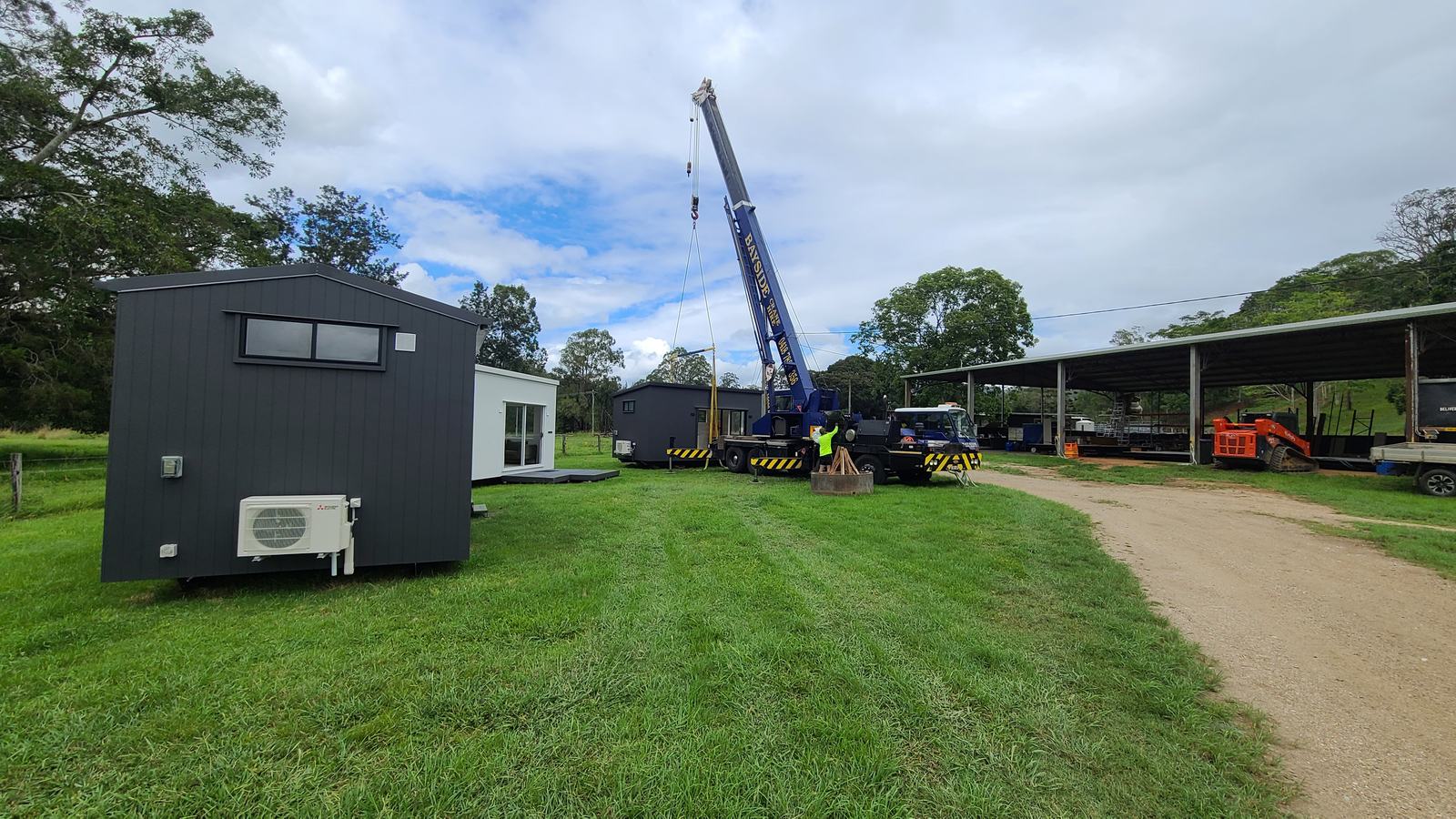
A module from a Brisbane maker comes up the range, so the route matters as much as the yard. In the older streets near the city, expect overhead power, street trees and established gardens. On the escarpment edge around Mount Lofty and Prince Henry Heights, slopes and long driveways can decide where a crane stands. Out on acreage the crane has room, but a soft paddock or a long gravel track after rain can hold up the truck. Check the route, the overhead power and where the outriggers land before booking.
Rural and acreage rules
In the Rural zone, a dwelling needs formed road access, a rainwater tank of at least 45,000 litres, wastewater treated under the Queensland Plumbing and Wastewater Code, and a 50 m setback from every boundary. It must also sit at least 1,000 m from an intensive animal industry, 500 m from a hard rock quarry, 200 m from a sand and gravel quarry and 100 m from a haul route. Height is 2 storeys or 10.5 m.
In the Rural residential zone the same access, wastewater and separation rules apply, the 45,000 litre tank is needed where there's no town water, and height is 2 storeys or 8.5 m. Council's building page says a second house on a rural lot should be self-contained, subordinate to and smaller than the main house, and meet the same requirements as the main house, and that building it doesn't entitle you to subdivide.
What an install costs in Toowoomba
Most installs run $59,000 to $140,000 inc GST, on top of the price of the home. In Toowoomba, budget separately for the half-rate infrastructure charge and for the longer haul up the range from a coastal maker. On rural land the tank, an on-site wastewater system and long runs to power push it up. A flat suburban lot near the sewer sits towards the lower end.
Questions about granny flats in Toowoomba
How big can a granny flat be in Toowoomba?
The planning scheme gives no floor area figure. It has to be used with, and subordinate to, the house on the same lot, and on rural land council expects it to be smaller than the main house.
Does Toowoomba charge infrastructure charges on a granny flat?
Yes. Council says secondary dwellings attract infrastructure charges, and Resolution No. 8 (2026) charges them at 50% of a dwelling: about $13,582 with two bedrooms or fewer, or $19,015 with three or more.
Can the granny flat have its own water meter and driveway?
Council lists separate utility connections, meters, driveways, mailboxes, bins and street addresses as signs a project is a dual occupancy. Keep those shared, and confirm metering with council's plumbing team.
Do I need council approval?
Usually not. Council says a secondary dwelling only needs building and plumbing approvals when it meets the accepted development requirements. Flood risk areas FR3 and FR4, character and heritage places, or missing a rule can change that.
Can I build over a council sewer?
Only within the Queensland Development Code MP1.4 rules, or with council's agreement under its wastewater policy. Multi-storey building over a sewer and work in a manhole clearance zone are not given discretion.
Can I rent it out?
Yes, to anyone. The state removed the family-only test in September 2022. It still has to stay secondary to the house and can't be sold separately.
Read next
- Queensland granny flat rules, explained
- Owner builder or licensed builder on a modular home
- Renting out a granny flat
- What a granny flat costs in SEQ
- Free block check
- Granny flats in Ipswich
- Granny flats in Brisbane
- Granny flats in Logan
Homes that fit a typical lot in Toowoomba
No GFA cap in the scheme; it must be used with, and subordinate to, the house on the same lot. There is no size cap, so these are homes up to 80 m², a common granny flat size. These are the lowest installed prices among the 187 homes from 25 m² to that size on the site, on an easy block, with homes the maker says are Class 1a first.
See all homes up to 80 m² Check your own block
Rule from Toowoomba's planning rules, checked October 2026. Installed prices are estimates on an easy block, inc GST. Your block decides the real number.
- Toowoomba, building in the Toowoomba Region
- Toowoomba Regional Planning Scheme v29
- Toowoomba Regional Planning Scheme v29, Schedule 1 definitions
- Toowoomba Regional Planning Scheme v29, Part 5 tables of assessment
- Toowoomba Regional Planning Scheme v29, Part 6 zone codes
- Toowoomba Regional Planning Scheme v29, Part 9 development codes
- Toowoomba, TLPI 01/2026 table of assessment for building work
- Toowoomba Infrastructure Charges Resolution No. 8 (2026)
- Toowoomba, building near a boundary or infrastructure
- Toowoomba, Wastewater Infrastructure Policy
- Toowoomba, Water Infrastructure Policy
- Queensland Government, secondary dwelling changes
- Ministerial statement, Queensland Housing Code
- Business Queensland, Queensland Development Code